
Уроки: видео на английском с субтитрами
75 видео на английском в разделе «Уроки»: уроки, песни и диалоги с субтитрами с переводом на русский. Смотрите и учите слова в LingTrio.
 A1Lesson 1Lesson 1: Greetings and Introductions In English, we have formal and informal greetings. Let’s look at some examples. Formal Greetings: Hello! Good morning! Good evening! How do you do?
 A1Lesson 2Lesson 2: Personal Pronouns and the Verb "To Be" Let's start with personal pronouns. These are words that replace names in sentences. Here are the main pronouns in English: I You (singular or plural)
 A1Lesson 2.1.Learning with LingTrio is easy and free! Use the platform at lingtrio.com, or download it from Google Play or the App Store to learn anytime, anywhere. New Simple Verbs
 A1Lesson 3Lesson 3: Question Words and Forming Questions Question words help us find information. Here are the most common ones: What — to ask about things (What is this?)
 A1Lesson 3.1Learning with LingTrio is easy and free! Use the platform at lingtrio.com, or download it from Google Play or the App Store to learn anytime, anywhere.
 A1Lesson 4Lesson 4: Nouns, Articles, and the Verb "Have" Today, we’ll learn about nouns, articles, and the verb have. Articles in English There are three main articles: a, an, and the.
 A1Lesson 4.1Welcome to Lesson 4.1 of LingTrio! Read both sentences. Choose the correct article (a, an, or the) in the second sentence. 1. I see ___ cat. ___ cat is black. ✅ Answer: XX 2. She eats ___ apple.
 A1Lesson 4.2Welcome to Lesson 4.2 from LingTrio! Today, we will focus on one important verb in English: have / has. Quick Review – “Have” and “Has” 🟢 Use have with: I, you, we, they 🟣 Use has with: he, she, it
 A1Lesson 5Lesson 5: Numbers and Telling Time Today, we will learn numbers from 1 to 100 and how to ask and answer questions about time. Numbers from 0 to 12: 0 — zero 1 — one 2 — two 3 — three 4 — four 5 — five
 A1Lesson 5.1Lesson: Numbers, Time, and Months — Let’s Practice! Learning with LingTrio is easy and free!
 A1Lesson 6Lesson 6: Adjectives and Comparisons Today, we will learn adjectives that help us describe people and things. big – small: This house is big. That house is small.
 A1Lesson 7Welcome to LingTrio! Today, we will learn about simple action verbs and sentence structure in English. 🔹 What are action verbs? Action verbs are verbs that describe actions.
 A1Lesson 7.1Today we’re going to talk about daily routines — the things you do every day. Morning, afternoon, evening — let’s go through it all! Daily Routine Verbs: wake up get up brush my teeth take a shower
 A1Lesson 8🎓 Welcome to LingTrio! Today’s Lesson: Present Continuous – Talking About What’s Happening Now 🔹 Present Continuous – What is it?
 A1Lesson 9Lesson 9: Past Simple Today we will learn how to talk about actions that happened in the past. 🔹 Regular verbs To form the past simple of regular verbs, add -ed to the base form. play → played
 A1Lesson 10Past Tense of “to be” and “to have” Today we will focus on the past tense of two important verbs: to be and to have. 🔹 The verb “to be” in the past tense
 A1Lesson 11🎓 Lesson 11: Pronouns, Possessive Forms & Days of the Week Today we will learn to use personal pronouns, possessive forms, and the names of the days of the week. 🔹 Pronouns and Possessives I – my
 A1Lesson 12🎓 Lesson 12: Modal Verbs – Can / Must / Should / Would Can — used to express ability or possibility. For example: Examples: Ability: I can swim. She can speak English. Permission:
 A1Lesson 13🎓 Future Simple & Going to – Talking About the Future In this lesson, we will learn how to talk about future actions. We'll use the verb will and the phrase going to. Examples: I go - I will go
 A1Lesson 14🎓 In this lesson, we will learn how to use basic prepositions to talk about time, place, and movement. Prepositions are small words that show the relationship between two things. For example:
 A1Lesson 15🎓 Welcome to Lesson 15 from LingTrio! Today we will learn three important verbs: see, look, and watch. 🔹 See Meaning: To notice something with your eyes without trying. Example Sentences:
 A1Lesson 16🎓 Using Two Verbs in English — What Form Comes Next? In English, we often use two verbs together in one sentence. But here's the challenge: The second verb doesn’t always follow the same rule.
 A1Lesson 17🎓 Today we will learn basic colors in English. Learning with LingTrio is easy and free! Use the platform at lingtrio.com, or download it from Google Play or the App Store to learn anytime, anywhere.
 A1Lesson 18🎓 Welcome to Lesson 18 from LingTrio! Learning with LingTrio is easy and free! Use the platform at lingtrio.com, or download it from Google Play or the App Store to learn anytime, anywhere.
 A1Lesson 19🎓 Welcome to Lesson 19 from LingTrio! Today we will learn how to talk about feelings, emotions, and states using adjectives. You will also learn useful verbs: feel, look, sound, and seem.
 A1Lesson 20🎓 Welcome to Lesson 20 from LingTrio! Let’s review everything we’ve learned — grammar, vocabulary, and sentence structure — in one fun story! Present: What I do every day
 A1ENGLISH BY SONGS – Nouns, Articles and HaveI see a cat. I see a dog. I have a pen. I eat an apple. I have an egg. I wait an hour. The sun is bright. The earth is big. The United States is a country.
 A2Lesson 22Hi! Welcome to Lesson 22 from LingTrio! Today we’re going to learn the Future Continuous tense — how to talk about what you will be doing at a specific time in the future. Let’s go!
 A2Lesson 24Today we will learn four very useful words in English: this, that, these, and those They help us talk about things near and far, and about one or many. What do these words mean?
 A2Lesson 23Welcome to Lesson 23 from LingTrio! Today we will talk about two beautiful things: the weather and nature. Let’s learn how to describe the world around you! Sunny
 A2Lesson 25Welcome to Lesson 25 from LingTrio! Today we will talk about the human body. Head & Face Let’s start with the head. You have one head and a face. eyes – I see with my eyes.
 A2Lesson 26Lesson 26: Clothes, Colors & Shopping In this lesson, we'll explore vocabulary related to clothing items, colors, and shopping phrases.
 A2Lesson 27Hello! Welcome to Lesson 27 from LingTrio! Today we will learn a new group of words in English — object pronouns. But first — let’s quickly review what we already know:
 A2Lesson 28Welcome to Lesson 28 from LingTrio! Today we will learn how to say “This is mine!” or “That book is theirs.” These words are called possessive pronouns. But first — let’s review what we already know.
 A2Lesson 29Welcome to Lesson 29 from LingTrio! Today we will talk about past habits and things we are used to. USED TO What does “used to” mean? We use used to when we talk about something that:
 A2Lesson 30Hi! Today we’re going to talk about places in the city. You will learn how to say where things are and how to ask for directions. Ready? Let’s go! Let’s start with some important places in the city.
 A2Lesson 32Hi! Welcome to Lesson 32 from LingTrio! Today, we’re going to talk about verbs again — but not just V1 and V2. We’re going to meet V3, the third form of the verb. Let’s go! 🔁 Quick Review: V1 – V2
 A2Lesson 33Lesson 33: Present Perfect – Past and Now Hi! Welcome to Lesson 33 from LingTrio! Today we’re going to talk about something new — the Present Perfect tense.
 A2Lesson 34Lesson 34: Past Perfect – What happened first? Hi! Welcome to Lesson 34 from LingTrio! Today we’re going to learn a new tense — the Past Perfect. Let’s go! When do we use Past Perfect?
 A2Lesson 35Lesson 35: Future Perfect – What will be done? Hi! Welcome to Lesson 35 from LingTrio! Today we’re going to learn the Future Perfect tense.
 B1Lesson 36Lesson 36: Perfect Tense Time Words – ever, never, already, yet In the last lessons, we learned how to use the Perfect tense. Now we’ll learn four words that are very common with this tense:
 B1Lesson 37: Conditionals: What They Are and How They WorkLesson 37: Conditionals – If this... then that! Hi! Welcome to Lesson 37 from LingTrio! What are Conditionals? Conditionals are sentences with "if".
 B1Lesson 38: So / Such / Too / EnoughLesson 38: So / Such / Too / Enough – Make Your English More Emotional Hi! Welcome to Lesson 38 from LingTrio!
 B1Lesson 39: Either / Neither / BothLesson 39: either / neither / both – Agree or Disagree Naturally Hi! Welcome to Lesson 39 from LingTrio! Today, we’re going to learn how to agree or disagree in a natural way using three simple words:
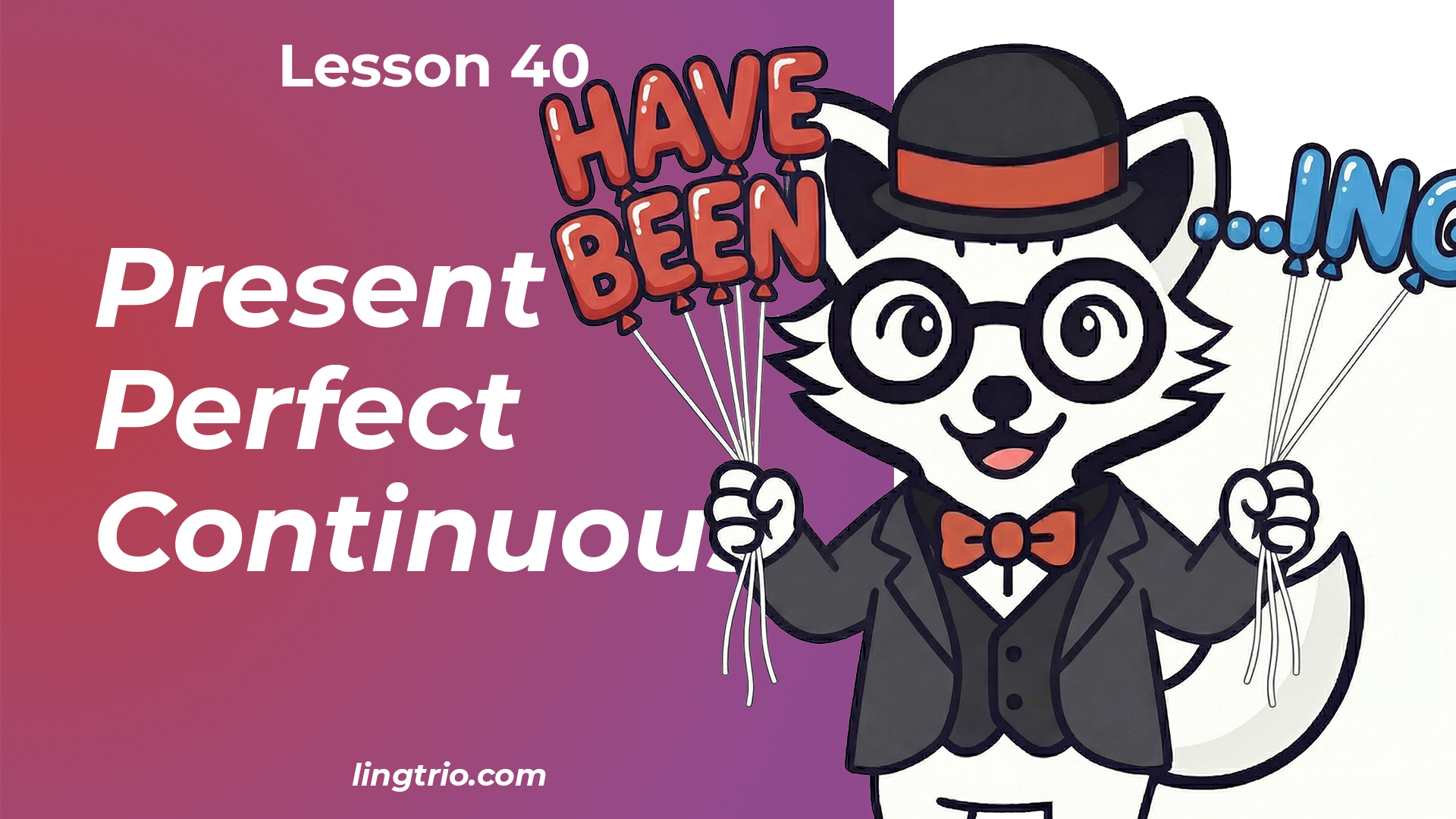 B1Lesson 40: Present Perfect ContinuousLesson 40: Present Perfect Continuous – How long has it been going on? Today, we’re going to learn a very useful tense: Present Perfect Continuous Why do we use Present Perfect Continuous?
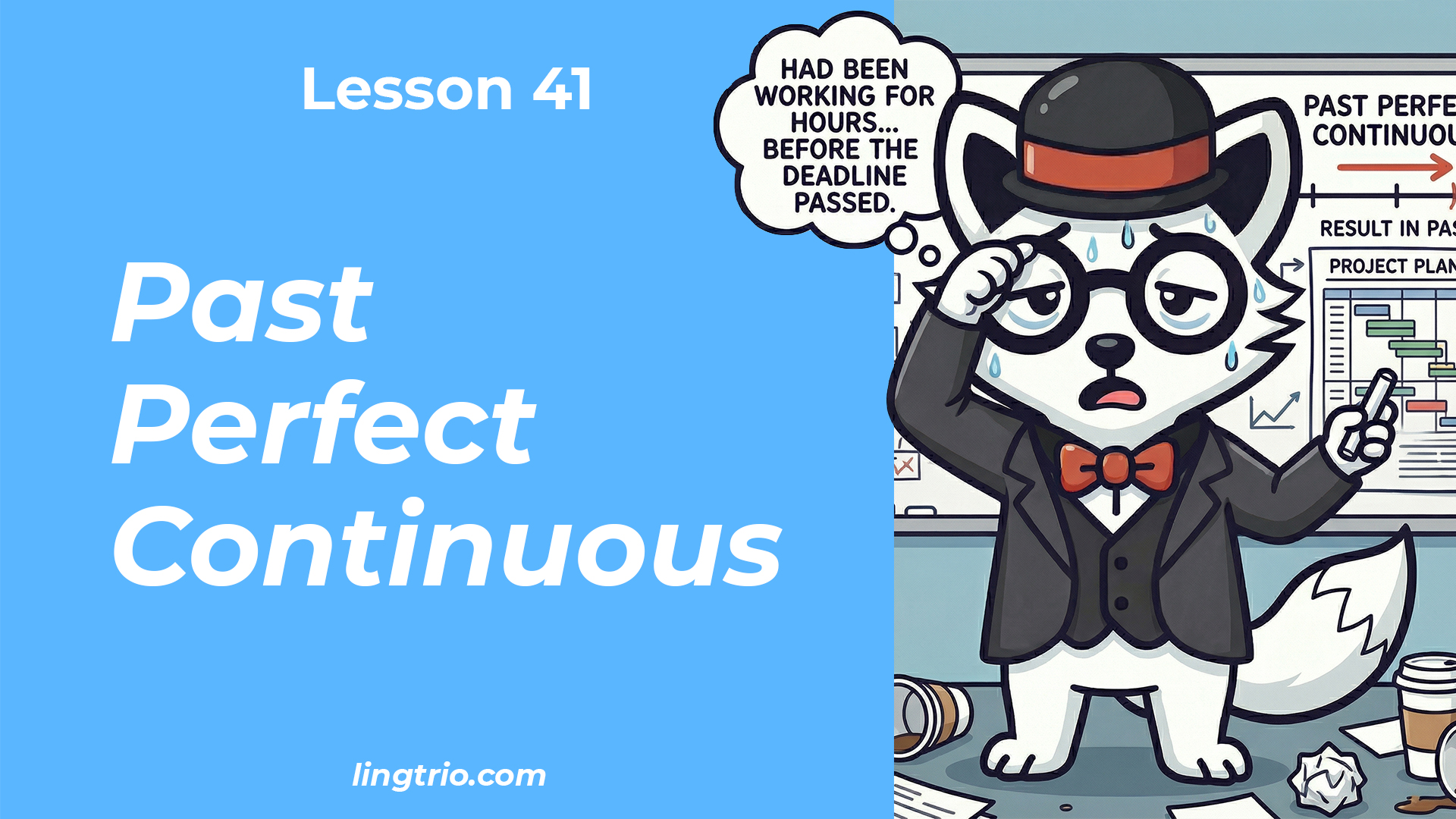 B1Lesson 41: Past Perfect ContinuousLesson 41: Past Perfect Continuous – What had been happening before? Today, we’re going to learn about another important tense: Past Perfect Continuous Why do we use Past Perfect Continuous?
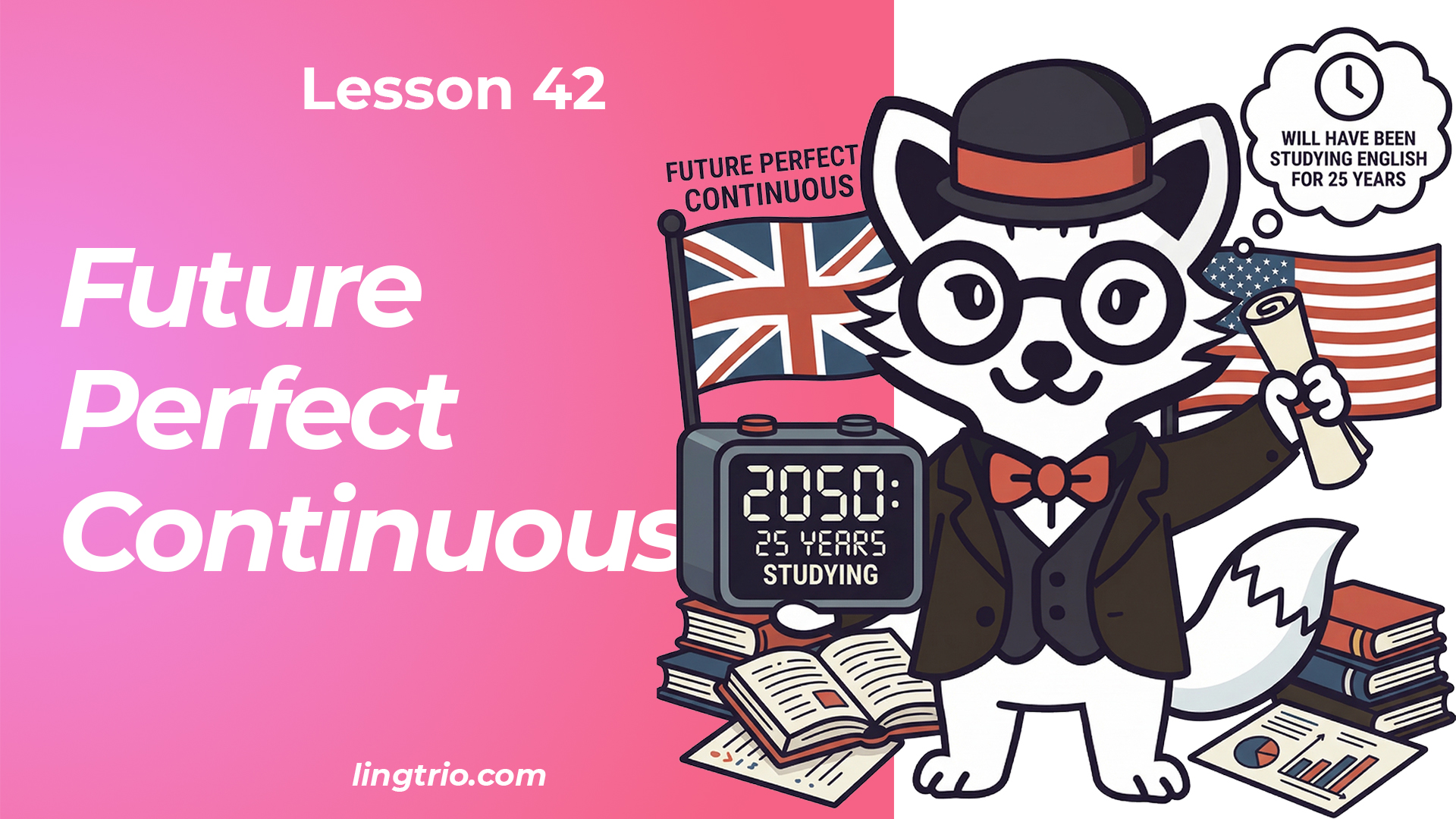 B1Lesson 42: Future Perfect ContinuousLesson 42: Future Perfect Continuous – How long will it have been happening? Welcome to Lesson 42 from LingTrio! Today, we’re going to learn another important tense: Future Perfect Continuous
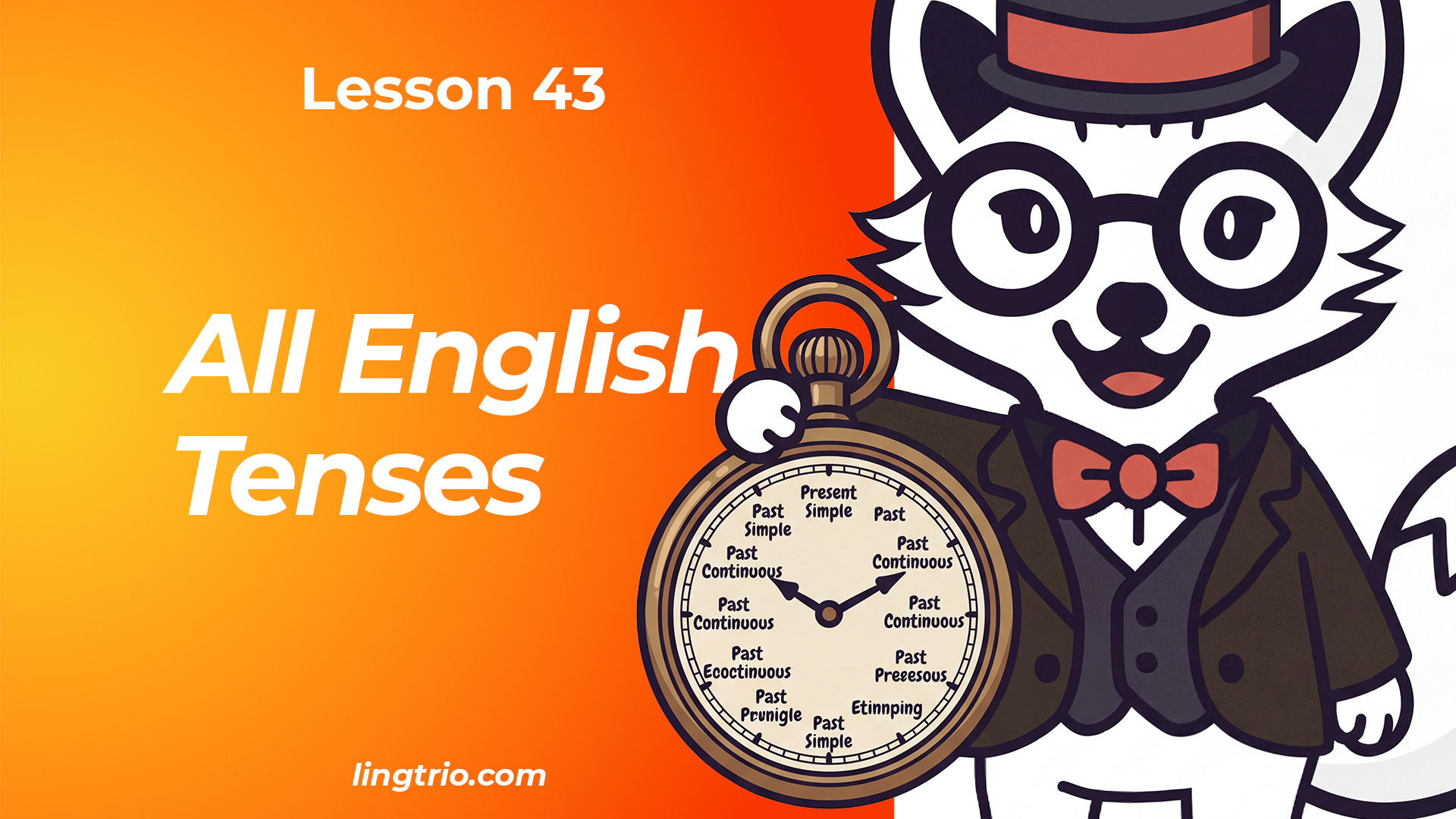 B1Lesson 43: All English TensesAll 12 Tenses with “I eat breakfast” — One idea, many meanings Today, you’ll learn how one simple idea — I eat breakfast — can be expressed in 12 different tenses with different meanings. Let’s go!
 B1Lesson 44: Question TagsToday, we’re going to learn how to make your English sound more natural with question tags. It’s easy and fun! Let’s go! What are Question Tags?
 B1Lesson 45: Should / Ought to / Had BetterLesson 45: Giving Advice – Should / Ought to / Had Better Hi! Welcome to Lesson 45 from LingTrio! Today, we’re going to learn how to give good advice in English using three easy expressions:
 B1Lesson 46: Can / Could / Be Able To — Full GuideToday, we are going to fully understand three important ways to talk about ability in English: Can, Could, and Be able to Let’s go! 1. What do they mean?
 B1Lesson 47: Passive Voice – Present and PastHi! Welcome to Lesson 47 from LingTrio! What is Passive Voice?
 B1Lesson 48: Passive Voice – Future and Perfect TensesHi! Welcome to Lesson 48 from LingTrio! In the last lesson, we already covered part of this topic. Today we will continue with Future and Perfect Tenses.
 B1Lesson 49: Reported Speech – Statements and QuestionsHi! Welcome to Lesson 49 from LingTrio! Today, we will learn about Reported Speech, focusing on Statements and Questions. What is Reported Speech
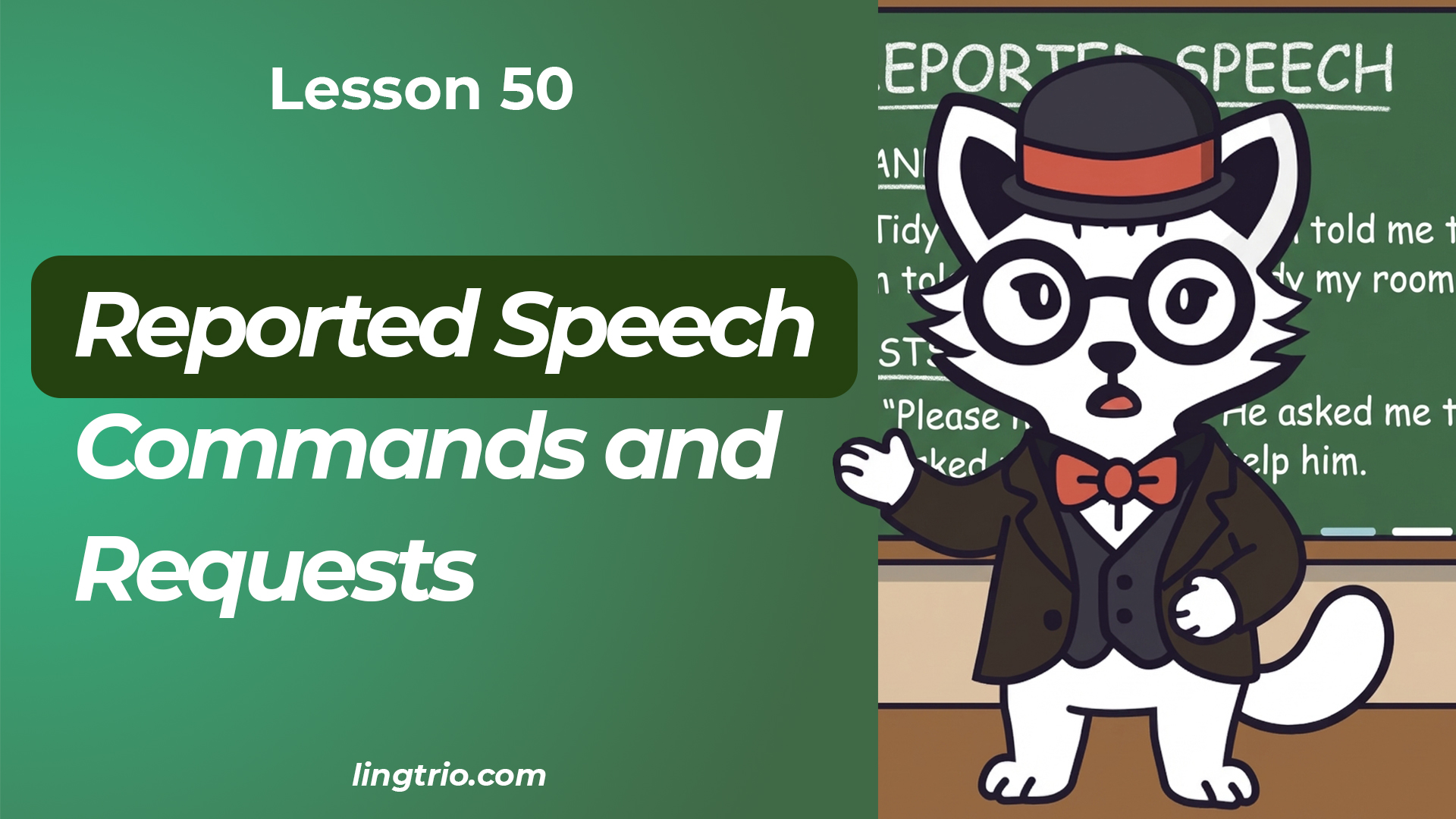 B1Lesson 50: Reported Speech – Commands and RequestsHello Welcome to Lesson 50 of LingTrio Today we will learn how to report commands and requests in indirect speech
 B1Lesson 51: Relative Clauses – Defining and Non-definingHi! Welcome to Lesson 51 from LingTrio! Today, we’re going to learn about some important parts of sentences that help us give more information about people and things:
 B1Lesson 52: Gerunds and Infinitives – Uses and DifferencesHi! Welcome to Lesson 52 from LingTrio! Today, we’re going to learn about two important forms of verbs that help you talk about actions: Gerunds and Infinitives – Uses and Differences
 B2Lesson 53: Modal Verbs for Probability and Deduction (must, might, can’t)Hi! Welcome to Lesson 53 from LingTrio! Today, we’re going to learn how to express certainty, possibility, or impossibility in English using some special modal verbs: must, might, can’t
 B2Lesson 54: Modal Verbs for Obligation and Permission (must, have to, may, can)Hi! Welcome to Lesson 54 from LingTrio! Today, we’re going to learn how to talk about rules, responsibilities, and permissions in English using some important modal verbs: must, have to, may, can
 B2Lesson 55: Advanced Conditionals – Mixed ConditionalsHi! Welcome to Lesson 55 from LingTrio!
 B2Lesson 56: Inversion in Conditional Sentences and Emphatic StructuresHi! Welcome to Lesson 56 from LingTrio! We've already talked about Conditional Sentences.
 B2Lesson 57: Emphatic Structures – Cleft Sentences (It is/was … that)Hi! Welcome to Lesson 57 from LingTrio! Today, we’re going to learn about Cleft Sentences, a powerful way to emphasize a particular part of a sentence using the structure "It is/was ... that".
 B2Lesson 58: Ellipsis and Substitution in EnglishHi! Welcome to Lesson 58 from LingTrio !
 B2Lesson 59: Advanced Phrasal Verbs – Separable and InseparableHello! Welcome to Lesson 59 from LingTrio !
 B2Lesson 60: Idioms and Expressions for Everyday ConversationHi! Welcome to Lesson 60 from LingTrio ! Today, we will learn about common idioms and expressions that you can use in everyday conversations to sound more natural and fluent. Let’s get started!
 B2Lesson 61: Collocations – Common Word Partnerships in EnglishHello! Welcome to Lesson 61 from LingTrio ! Today, we will explore collocations. Let’s get started ! Why are collocations important? They make your language sound more natural and fluent.
 B2Lesson 62: Formal vs Informal English – When and How to Use ThemHello! Welcome to Lesson 62 from LingTrio ! Believe in yourself — you are capable of amazing things. Today, we will learn about formal and informal English. Let’s get started !
 B2Lesson 63: Writing Skills – Paragraph Structure and CoherenceHi there! Glad to see you on Lesson 63 from LingTrio ! Today, we’re going to talk about how to write great paragraphs so your ideas are clear and easy to understand. Ready? Let’s go !
 B2Lesson 64: Writing Skills – Formal Letters, Emails, and ReportsHi again! Glad to see you back for Lesson 64 from LingTrio !
 B2Lesson 65: Speaking Skills – Giving Presentations and Public Speaking TipsHi there! Glad to see you on Lesson 65 from LingTrio !
 B2Lesson 66: Listening Skills – Understanding Different Accents and SpeedsHi! Welcome to Lesson 66 from LingTrio ! Today, we’re going to improve your listening skills by learning how to understand different accents and speech speeds.
 B2Lesson 67: Advanced Vocabulary Building – Academic and Professional ContextsHi! Welcome to Lesson 67 from LingTrio !
 B2Lesson 68: Synonyms, Antonyms, and Nuances of MeaningHi! Welcome to Lesson 68 from LingTrio ! Today, we’re going to explore synonyms, antonyms, and the subtle differences in meaning between similar words.
 B2Lesson 69: Grammar recap p.1Hi! Welcome to Lesson 69 from LingTrio !
 B2Lesson 70: Grammar recap p.2Hello ! Welcome to the final lesson of the grammar review series on Lingtrio !